Equipment
Large and medium power transformers
Power transformers step voltage up or down between transmission, sub-transmission and distribution systems. They are built to order, they are heavy, and they are the item most likely to set the schedule for a substation or interconnection project.
Rating ranges we work with
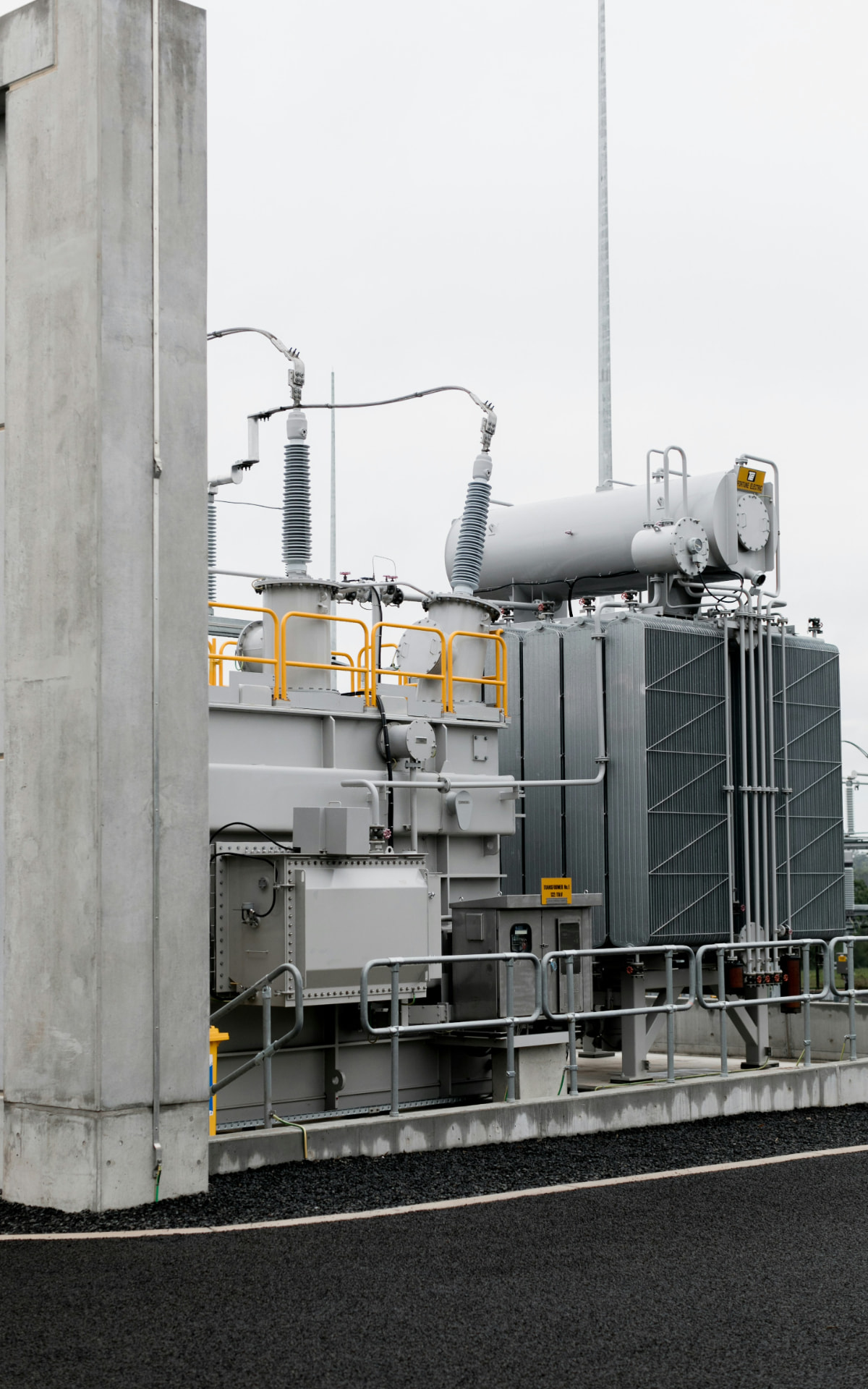
We source medium power transformers, roughly 10 to 100 MVA, and large power transformers from about 100 MVA to well over 1,000 MVA. That covers most transmission substations, utility-scale generation interconnections, large industrial loads and data center campuses.
Within those ranges we see two-winding and three-winding units, autotransformers for transmission interties, and specialized designs such as phase-shifting transformers. Each of these is effectively a custom product, even when two units share the same nameplate MVA rating.
Where they are used
Most of the requests we handle fall into a few groups:
- Utility transmission and distribution substations, for new capacity, replacements and system spares.
- Generation interconnections, where the main power transformer or GSU transformer connects a plant to the grid.
- Data center campuses that take service at transmission voltage and build their own substation.
- Heavy industry, including mining, metals, chemicals and hydrogen projects.
A large power transformer is a long-lived asset. Hitachi Energy notes that large power transformers can operate for up to 40 years, which is one reason utilities are careful about specification and condition when they buy.
What drives lead times
According to Wood Mackenzie's Q2 2025 survey, as reported by POWER Magazine, average lead times reached 128 weeks for power transformers. Prices have risen as well: Wood Mackenzie estimated in 2025 that power transformer prices were up about 77% since 2019.
Several factors sit behind those numbers. Demand has grown from generation interconnections, data centers and replacement of aging equipment at the same time. Factory capacity for the largest ratings is limited and expands slowly. Supply is also heavily international: Wood Mackenzie estimated that about 80% of large power transformers used in the U.S. in 2025 are imported, which brings shipping time, tariffs and country-of-origin rules into every decision.
Logistics matter too. The U.S. Department of Energy estimated in 2014 that transport and logistics account for roughly 3% to 20% of the total cost of a large power transformer. Heavy-haul routes, rail access and permits can add months if they are left until late.
For current figures with sources, see our lead times and prices update.
Options beyond a new factory order
A new order is often still the right answer, but it is rarely the only one. We look at open and released production slots at domestic and overseas factories, including manufacturers with shorter queues than the largest names. We also look for surplus and never-energized units from cancelled projects and utility spares.
Each route has trade-offs in cost, delivery date, warranty and how closely the unit matches your design. We lay those out side by side so your team can compare them on the same basis.
What we check
MVA and voltage get a unit onto the list. Whether it can go on your pad depends on the rest of the specification: BIL, impedance, vector group, tap changer type and range (OLTC or DETC), cooling class such as ONAN or ONAF, temperature rise, sound level and site conditions. The full list is on our specification matching section.
For any unit that is not a new build, we also collect ownership documents, factory test reports, DGA history and storage records. That process is described under verification.
Starting a search
The most useful starting point is your specification or single-line diagram, the required energization date and the site location. If you are still early in design, a rating range and voltage class are enough for a first look at the market. You can start a search or read how we run one.
FAQ
Common questions
Can you find a power transformer that matches an existing unit?
Usually we start from the nameplate and test records of the unit being replaced. We search for options with the same ratings, impedance and footprint, and we note any differences your engineers would need to review.
Do you look at both new-build and existing units?
Yes. For each search we ask manufacturers about open and released production slots and, in parallel, look for surplus and never-energized units that fit the specification.
What information do you need to start a power transformer search?
MVA rating, primary and secondary voltages, impedance, BIL, cooling class and the required delivery date. A spec sheet or single-line diagram is the easiest way to share these.
Tell us what you need.
A 15-minute call is usually enough to scope a search.
Contact details coming soon